
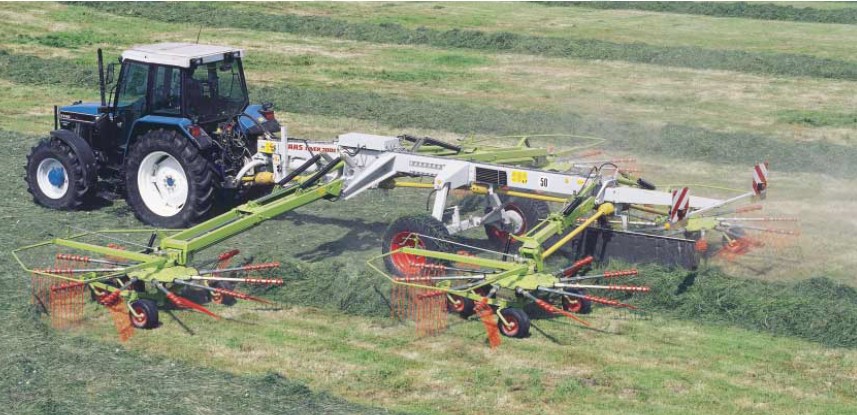
Practical test: Electro-hydraulics play a big part in the Claas Liner 3000 four-rotor rake, which is capable of gathering in a massive 12m of grass into the one swath. Is such sophistication justified on what is generally regarded as a simple piece of kit? We assess the big Liner’s crop-gathering credentials in this month’s profi practical test
Flicking through the first pages of the Liner 3000’s manual, an operator could be forgiven for approaching this machine with some trepidation. Electronics everywhere. With so much text devoted to the control system, the natural assumption is that this must be an extremely complex machine to operate.
Wrong. Don’t be put off, because all of the Liner’s main base settings are pre-set for immediate use. Indeed all that the operator needs to know is how to activate the electrohydraulic system – and that’s it. But more on the electro-hydraulics later. First, to couple the machine to the tractor. Not too much trouble here, with the rake’s high-mount hitch design giving a clear view of and access to its pins. Less convenient is the lack of a pto shaft storage bracket and a stand/locking pin arrangement that is not the easiest to use. Potential for grazed knuckles etc.
Requirements from the towing tractor are not too demanding. In terms of hydraulics, this requirement translates into just the one double-acting spool or, if this is not available, one single-acting supply with a return. A couple of points to note here: It’s important not to mix up the supply and return pipes; and, on constant flow/pressure tractors, it may be necessary to adjust the valve chest’s set screw.
For more up-to-date farming news click here and subscribe now to profi and save