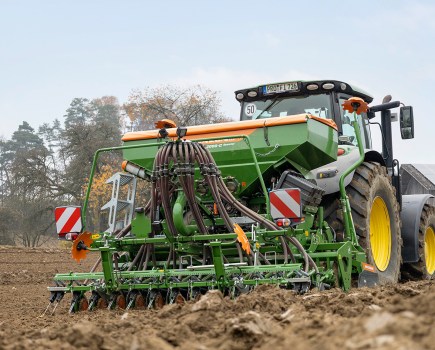

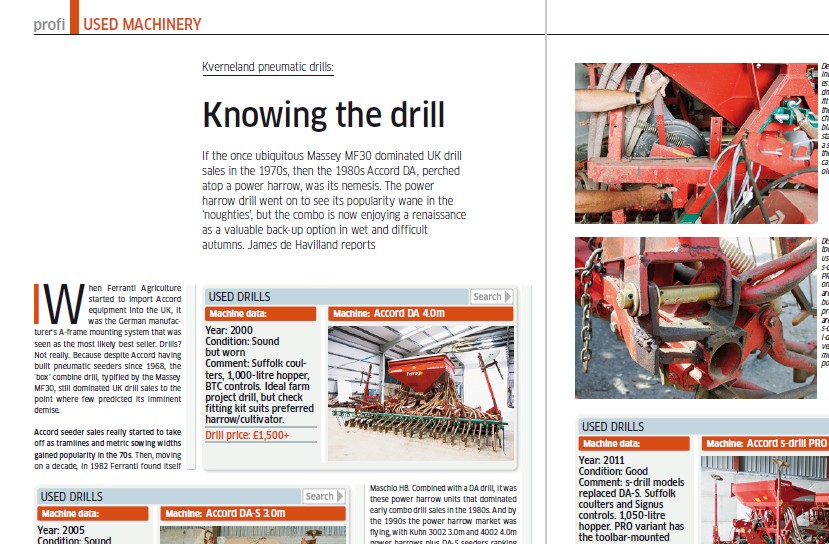
USED MACHINERY: If the once ubiquitous Massey MF30 dominated UK drill sales in the 1970s, then the 1980s Accord DA, perched atop a power harrow, was its nemesis. The power harrow drill went on to see its popularity wane in the ‘noughties’, but the combo is now enjoying a renaissance as a valuable back-up option in wet and difficult autumns. James de Havilland reports
When Ferranti Agriculture started to import Accord equipment into the UK, it was the German manufacturer’s A-frame mounting system that was seen as the most likely best seller. Drills? Not really. Because despite Accord having built pneumatic seeders since 1968, the ‘box’ combine drill, typified by the Massey MF30, still dominated UK drill sales to the point where few predicted its imminent demise.
Accord seeder sales really started to take off as tramlines and metric sowing widths gained popularity in the 70s. Then, moving on a decade, in 1982 Ferranti found itself on the cusp of the power harrow drill system revolution. In 1983 alone, Ferranti had an order book for over 1,100 Accord DL and DA drill units, and, as the power harrow drill increased dramatically. Other beneficiaries, alongside Accord, included Lely with its Roterra 32 and 33 and 44 series, and the Maschio HB. Combined with a DA drill, it was these power harrow units that dominated early combo drill sales in the 1980s. And by the 1990s the power harrow market was flying, with Kuhn 3002 3.0m and 4002 4.0m power harrows plus DA-S seeders ranking among the top combination sellers of that decade.
Although power harrow drill sales started to wane at the turn of the century, they’ve never plummeted completely, and the concept has retained a strong and loyal following in certain regions — as well as on the Continent. This has helped to spur a degree of design development, with manufacturers increasingly offering their own drill and harrow combos.
For more up-to-date farming news click here and subscribe now to profi and save