
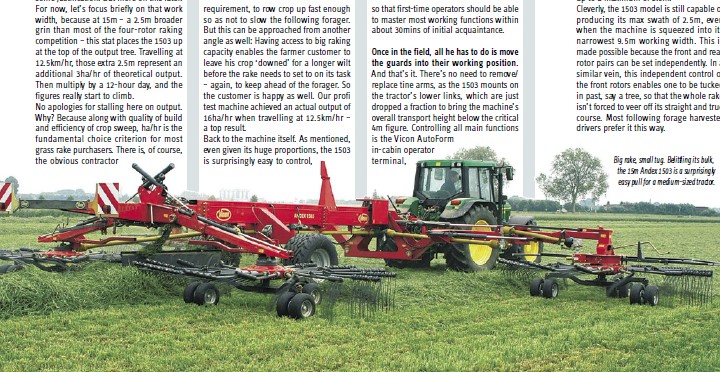
Practical test: Vicon Andex 1503 four-rotor rake Four-rotor rakes would appear to be the way to go for larger foraging contractors – that’s if additional size is taken as an accurate barometer of future machinery buying trends. Main plus point, of course, is that these giant twizzlers represent the obvious approach to satiating considerable SP forager appetites. We test the Vicon variant, the 15m wide Andex 1503
Viewed from the air, the Andex 1503 looks like something out of ‘Walking with Dinosaurs’. Gargantuan body. Telescopic arms. Bared, rotating teeth at all corners, consuming everything in their path. Quite a sight. Almost scary.
Or it would have been a number of years ago. The fact is that these four-rotor rakes are now more commonplace, their sales popularity having grown alongside the rapid rise in self-propelled forager horsepower and output. To extract maximum grass-gobbling potential out of a 500hp+ forager model, there is a band of opinion that says four raking rotors are required, hence the appearance of these machines on the UK market.
So we weren’t intimidated by the 1503, despite its awesome 15m working width. Ease of use, after all, is one of the rake’s traits that Vicon is keen to push, and with some justification. But more on this later. For now, let’s focus briefly on that work width, because at 15m – a 2.5m broader grin than most of the four-rotor raking competition – this stat places the 1503 up at the top of the output tree. Travelling at 12.5km/hr, those extra 2.5m represent an additional 3ha/hr of theoretical output. Then multiply by a 12-hour day, and the figures really start to climb.
No apologies for stalling here on output. Why? Because along with quality of build and efficiency of crop sweep, ha/hr is the fundamental choice criterion for most grass rake purchasers. There is, of course, the obvious contractor